

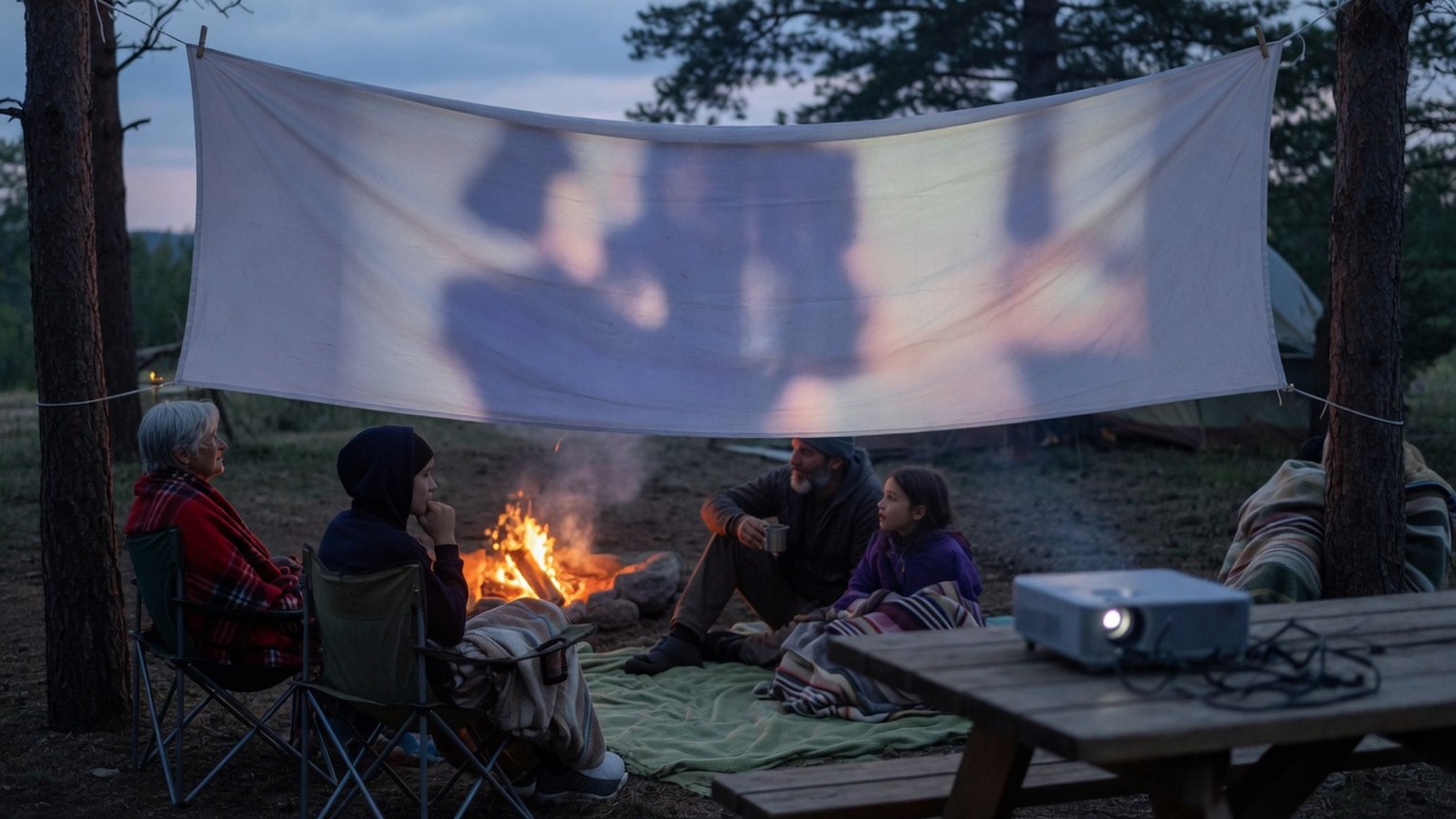
There is a particular kind of quiet that settles over a campground around seven o’clock in late October. The fire is going, the temperature has dropped, everyone is fed, and nobody is quite ready for bed. That is the exact window a campfire movie night was made for. A sheet, a small projector, and a stack of blankets turn a dark campsite into the reason your group stays up talking about the trip long after the season ends.
The good news is that you do not need a giant inflatable screen or a generator to pull it off. Most of what makes an outdoor movie work is planning: where people sit, where the light comes from, and how loud you let it get. Here is how we set one up at camp without hauling half the house along.
Why Fall Is the Best Season for a Campground Movie
Timing is everything with this idea, and October hands it to you for free. Sunset comes early, so you are not waiting until nine o’clock for the picture to look right, and kids who would fight a bedtime at home will happily sit still under a quilt once the screen lights up.
Cool air helps in a less obvious way too. A movie night gives a group something to do together that does not require anyone to be entertaining. If your camp has a mix of ages, or a few people who are not big hikers, it is a low-effort way to make sure everyone has a good evening. Pair it with the kind of camp games for large groups that burn energy before dark, and you have a full day that ends on a high note.
The Short List of Gear That Actually Matters
You can spend a lot of money on this hobby, and none of it is required. A basic setup that works reliably looks like this:
- A projector with a built-in battery and a speaker — one device, one cable, fewer things to forget
- A white sheet or a purpose-made screen, plus two poles, trees, or the side of a camper to hang it from
- A phone or laptop with the movie downloaded ahead of time, since camp wi-fi is a fantasy
- A small Bluetooth speaker if the projector’s audio is thin
- A power bank and a short extension cord as backup
- Blankets, camp chairs, and a couple of tarps for ground seating
Brightness matters more than resolution outdoors. A dim projector washes out the moment there is any ambient light, so read the specs for brightness first and treat 1080p as a nice-to-have. Many portable projectors run a couple of hours on their own battery, which is usually enough for one film if you charge it during the day.
For the cold half of the equation, the same cozy campfire gear that makes a fall evening comfortable does double duty here: a wool blanket, a lap throw for each kid, and a thermos that keeps cocoa hot for two hours.
Setting Up the Screen So Everyone Can See
Hang the screen so the bottom edge sits at about eye level for a seated person. Too high and everyone spends the movie craning their neck; too low and heads block the picture. If you are tying a sheet between two trees, pull it taut — a sagging sheet catches wrinkles that show up as shadows on faces.
Then think about what is behind and around the screen. You want darkness behind it so light does not bleed through, and you want the audience facing away from any campground lamp, bathhouse light, or glowing camper window. Turn off your own lanterns and string lights for the duration. It feels counterintuitive to make camp darker, but the picture improves dramatically, and the darkness is half the atmosphere.
Set the projector on a stable table or the tailgate of a truck, not on a camp chair. Even a small bump knocks the image off the sheet, and guests will spend the whole film watching you readjust it. A folded towel under the projector helps absorb vibration from footsteps.
Sound, Power, and Being a Good Neighbor
Volume is where a great movie night can turn into a complaint. Keep the speaker pointed at your group rather than across the campground, and set the level so it is comfortable at the back row and no further. If you can hear the dialogue clearly from thirty feet away, it is probably too loud for the site next door.
Quiet hours are usually the deciding factor. Many campgrounds enforce them from ten o’clock, and some private glamping properties ask for quiet earlier. Pick a movie that ends before that window, and have a plan for the last twenty minutes if it runs long — subtitles on, volume down is a perfectly good compromise.
Power is the other practical snag. Run an extension cord from a pedestal only if your site has one and the cord is not crossing a path. Otherwise, charge the projector and speaker during the day and skip the cord entirely. Test the whole setup at home first, including the cable you plan to use, because a missing adapter is the most common reason these nights fizzle.
A Simple Evening Timeline
The version that works best for us starts well before dark. Around five, set up the screen and run a five-minute test with the actual movie file. Eat dinner at six, and let the fire burn down while people change into warmer layers. Start the film at first real darkness, which in late October is early enough that younger kids can finish it.
Have a short intermission planned rather than pausing whenever someone needs something. That is the moment for refills, bathroom trips, and adding another log. When the credits roll, leave the screen up for a few minutes and let people linger — that post-movie conversation around the fire is often the best part of the night.
If the sky is clear, this is also a good excuse to leave the projector off for ten minutes and look up. The same dark sky that makes a movie look good is what makes the stargazing essentials worth packing, and a quick constellation tour is a nice palate cleanser between films.
Snacks That Do Not Require a Kitchen
Movie snacks should be things people can eat in the dark without a plate. Popcorn made ahead at home and carried in a sealed container works better than a campfire batch that goes stale by showtime. Add a bowl of trail mix, some apples, and a bar of chocolate broken into squares, and you have the whole concession stand.
For drinks, a thermos of hot cider or cocoa handles the cold better than anything poured over ice. Keep cups lidded so a knocked-over mug does not end the evening. If you are watching with a group, set the food on a table behind the seating rather than in front of the screen, so nobody is silhouetted getting up for seconds.
Plan for Weather, Rules, and the Walk Back
A drizzle does not have to cancel the night if your projector stays dry under a canopy and the screen is a material that can handle damp. Wind is the bigger enemy; a sheet acts like a sail. Check the forecast the morning of, and have a backup plan that does not involve a screen — a fire, a deck of cards, or one of these family camping movies watched on a laptop inside the camper is a perfectly respectable rain option.
Before you commit, check the campground’s rules about amplified sound, generators, and lights-out. A quick call or a look at the welcome sheet saves an awkward conversation at nine o’clock. And bring a headlamp for the walk back to the tent. After two hours of screen light, the path will look much darker than it did on the way over.
Make It a Camp Tradition
The best part of a campsite movie night is how little it costs relative to how much people remember it. One film, one sheet, and a fire that stays lit until the credits end is enough to turn a regular fall weekend into the trip your family asks for again next year. Pick a title everyone can agree on, get the screen up before the light goes, and let the evening run slow. Happy glamping — and happy watching.


